Slovenščina
  Hrvatski
  Italiano
  Deutsch
Everything You Need to Know About Dental Implant Placement: Answers to Your Questions
Everything You Need to Know About Dental Implant Placement: Answers to Your Questions

We are happy to share our knowledge with you and through expert advice we want to educate you about the importance of oral health care and the possibilities that modern dentistry offers you at our center. Get in touch with us on +385 1 4059 749 or you can reach us on our free UK number at +44 800 08 68 414. You can also email us at info@drstimac.com.
Dental implant placement is now a highly advanced and predictable dental procedure. Many patients have similar questions—does it hurt, how long is the recovery, what if I need to fly, will my body accept the implant, and so on. Here are the answers, based on our clinical experience and expertise, to reassure you that you are truly in the right hands.
1. How painful is the entire implant placement procedure?
The procedure is performed under local anesthesia, which means you do not feel pain during the surgery itself. If the sounds of the dental office make you uncomfortable, we also have a solution for that—specialized headphones that block out unpleasant background noise. In our work, we use high-quality dental implants and advanced methods such as digital guidance, precise surgical templates, and minimally invasive techniques, all of which significantly reduce discomfort and shorten recovery time.
2. How long is recovery after dental implant placement?
The osseointegration period—the time needed for the implant to fuse with the bone—usually lasts 3 to 4 months. If an additional procedure such as bone grafting or a sinus lift was necessary, recovery may take longer.
3. How long will it take me to get used to implants?
Once the dental implant is placed and the temporary or final restoration (crown, bridge, or denture) is fitted, most patients adapt within a few weeks—the feeling is very similar to that of a natural tooth. During the first few weeks, you may notice differences when chewing, speaking, or feeling the implant area with your tongue, but this gradually disappears as the muscles and soft tissues adapt.
4. Can I travel by plane after getting implants?
Yes—generally there are no special contraindications to flying after dental implant placement. However, it is recommended to wait at least a few days after surgery, once the initial healing phase has begun and pain and swelling have decreased.
If you had more extensive surgery, such as bone grafting or a complex implant case, it is best to consult your dentist before traveling.
You should also pay attention to maintaining oral hygiene while traveling and avoiding heavy exertion or lifting.
5. What materials are dental implants made from?
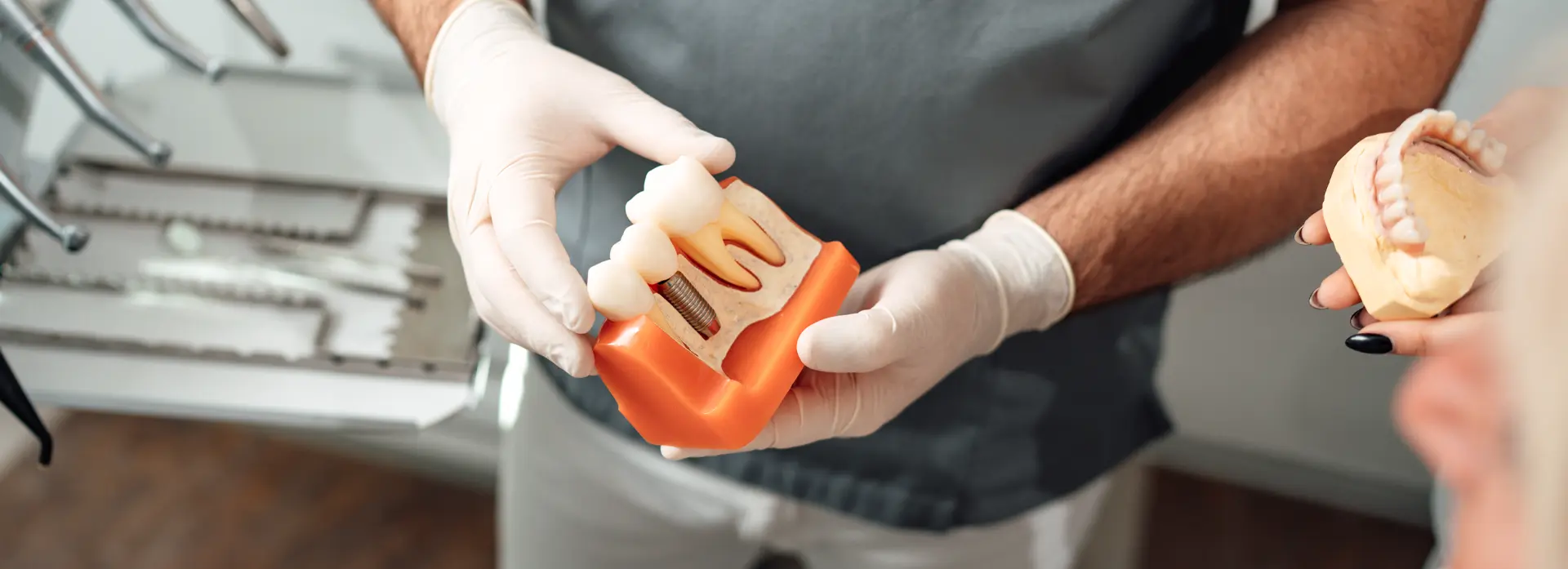
The most common implant material is titanium, due to its biocompatibility—that is, its excellent acceptance by the body and very low risk of rejection.
Some abutments may be made of zirconia, especially when improved aesthetics are desired, for example in the front part of the jaw.
6. Can we choose which implants we want?
At our center, after a detailed diagnostic examination and review of your X-rays, the oral surgeon will recommend either Bego or Nobel Biocare implants, depending on the volume and structure of your bone.
At our center, after a detailed diagnostic examination and review of your X-rays, the oral surgeon will recommend either Bego or Nobel Biocare implants, depending on the volume and structure of your bone.
These are premium implant systems that meet the highest international standards according to all major global quality benchmarks. The choice depends on several factors: the quantity and quality of the bone, tooth position, aesthetics, budget, and the patient’s overall health.7. Do dental implants come with a lifetime warranty?
The warranty on the prosthetic construction placed on the implant (abutment and crown) is 3 years. Any chipping of ceramic or acrylic parts of the prosthetic restoration is also covered by a 3-year warranty.
After surgical implant placement, all our patients receive an implant passport containing the date of surgery, the manufacturer, the serial number of the implant, and the implant position, as proof of authenticity and quality.
It is important to understand that warranty coverage usually depends on whether the patient maintains good oral hygiene, attends follow-up visits, properly manages any health conditions such as diabetes, and does not smoke, as smoking reduces the success rate of dental implants.
8. Will the body reject the implant?
Dental implant rejection is very rare. Clinical success—meaning the implant integrates properly with the bone—is very high in the vast majority of cases, generally above 95%.
Reasons an implant may fail include insufficient bone quality or quantity, poor oral hygiene, uncontrolled disease such as diabetes, smoking, infection, or not following the dentist’s instructions.
If the implant does not integrate properly, most clinics can attempt the procedure again after the area has healed.
9. What is the price of dental implants?
At our clinic, the price of a single dental implant depends on the implant manufacturer and the material of the crown placed on the implant. Prices range from €1,170 to €1,580, and include surgical placement, the abutment, and the implant crown. Until the end of the month, we are offering a 20% discount for cash payments and a 10% discount for card payments on the surgical placement of dental implants.
For larger procedures, such as All-on-4 or full bridges on four implants, costs are higher. At our dental center, these full-arch prosthetic restorations range from €5,400 to €6,280 per jaw for All-on-4 and semi-fixed solutions, depending on the bridge, materials, and additional procedures required. As with single implants, until the end of the month we are offering a 20% discount for cash payments and a 10% discount for card payments on fixed solutions for edentulous jaws.
Overall, implant placement is now a routine, safe, and effective way to restore the function and appearance of your smile. With proper planning, quality materials, an experienced surgeon, and good compliance with post-operative instructions, pain is minimal, recovery is relatively quick, and success rates are very high.
Book your appointment for a free clinical dental examination before implant placement through our online form.