Slovenščina
  Hrvatski
  Italiano
  Deutsch
How to get rid of a toothache?

How to get rid of a toothache?

We are happy to share our knowledge with you and through expert advice we want to educate you about the importance of oral health care and the possibilities that modern dentistry offers you at our center. For all other information, you can always contact us at info@drstimac.com or call us at +385 1 36 33 602
Toothache, or pain in a tooth or teeth, is a very common condition both in children and adults.
Toothache normally refers to pain in or around a tooth or in the jaw. Tooth pain can cause great discomfort, its intensity decreasing or increasing over time. This pain may be permanent or caused by external stimuli such as heat, cold, sweet or sour food or liquid, chewing, or even brushing habits.
What are the most common causes of toothache?
The most common causes of toothache are:
- Tooth decay
- Damaged (lost) filling
- Nerve infection
- Teething
- Trauma
What are the symptoms of toothache?
- Intense pain (sharp, stabbing)
- Swelling around a tooth (gums)
- Headache and/or fever
- Earache
- Strange taste in the mouth (possibly due to a discharge from the tooth caused by an infection)
Toothache normally occurs when we least expect it – late at night, on a weekend or in any other situation where you are unable to see a dentist immediately.
When this happens, many people seek relief in painkillers, which is a short-lasting solution – it is absolutely necessary to see a dentist as soon as possible to start treating the cause immediately and make the pain go away.
How can a dentist help with pain in the oral cavity?
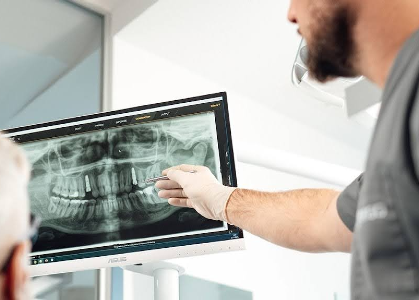
The dentist will definitely talk to the patient to learn their medical history and ask them about the location and type of pain to determine what the problem is. In the case of toothache, it is recommended to make a panoramic scan (orthopantomogram) which shows the entire jaw, including a potential inflammatory process. Based on the orthopantomogram, the dentist will immediately determine the necessary treatment.
If the patient has a cavity, the dentist must clean the tooth of tooth decay and see the depth of the cavity and how much of the tooth is affected. If the cavity is a small one, the doctor will insert a white material referred to as filling, which ends the treatment.
If the dentist detects a dental nerve infection, treatment must be initiated immediately, by cleaning and filling the root canal to remove the deposited bacteria.
If the affected tooth is in a very bad condition, it cannot be treated, so the only option is to remove it. If the dentist reaches such conclusion in the process of making the diagnosis, it would be advisable to remove the tooth immediately to stop the pain and soothe the gums.
After the cause is detected and eliminated and the symptoms begin to subside, it would be advisable to revisit the dentist to assess the current situation and review the state of the teeth.
In such a case where it is necessary to remove a tooth, the patient should definitely discuss with their doctor the possible solutions for the missing tooth. Prolonged lack of a tooth may result in other issues – primarily in extra space between teeth, which is not desirable because this may eventually disrupt the entire dental structure.
A missing tooth can be replaced with either an implant or a prosthesis – a crown to fill the void.
Is it possible to prevent toothache?
Statistically, tooth decay is the primary cause of toothache, which indicates that regular maintenance of oral hygiene may largely prevent toothache. Good oral hygiene includes:
- brushing your teeth at least twice a day;
- flossing on a daily basis;
- using mouthwash on a daily basis; and
- using an interdental brush on a daily basis.
In addition to daily oral hygiene routines, it is very important to see your dentist on a regular basis to allow them to respond on time and prevent major consequences such as loss of a tooth.